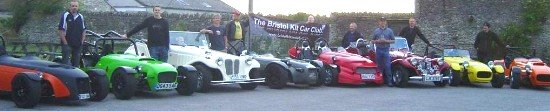
• Welcome to Bristol Kit Car Club and Forum - BKCC.

 

News:

A big thanks to all members past and present for making the club viable for so long.

Main Menu
AIB BKCC Kit Car Insurance
Discounts For Club Members

+-Member Login or Register

Welcome, Guest.
Please login or register.


Forgot your password?

Rolling Road feature.

Started by SPAXIMUS, 25, April, 2012, 03:29:30 PM

Previous topic - Next topic

SPAXIMUS

I have just finished my latest Westfield build and needed to get it set up on a rolling road as well as an MOT. So I booked a session at Interpro in Thornbury to do both jobs. It struck me, after speaking with my Father in law, that many have heard about rolling roads but what is one and how does a day go? So here is what happened for me.
A rolling road is a dynamometer which allows a car to run at various revs and road speeds with load applied. It then uses a calculation to measure the power the engine makes and the drag on the transmission to arrive at a BHP and torque figure at the flywheel.
To get the best from each individual car adjustments have to be made to optimise the running. On normal carburettor equipped cars this is done by changing jets and depending on the ignition set up adjusting various things like timing and dwell angles to get the best compromise set up. On carbs this compromise is always wider than on a fuel injected electronic ECU equipped car. On such a car the adjustments are made at many points across the ignition and fuelling, the difference is all adjustments are made on a lap top in real time.
My car is equipped with a set of jenvey throttle bodies and an MBE ECU. I had already balanced all the throttle bodies, set the throttle cable to ensure full throttle was working and set the fuel pressure before going to Interpro so that was one job that saved time.
The first task for Dave, one of the owners of Interpro, was to mount the car on the rollers and with various brackets and straps, securely fastened the car down. This sounds simple but to do it right took a good half hour. He then connected the lap top and typed the correct code to enter the ECU and connected the exhaust extractor and all the relevant cables as well as two huge fans to keep everything cool. He then installed a lambda sensor into the exhaust to measure the hydro carbons and CO. Each ECU will have a base map installed designed just to fire a car up, some of these will be very close to what it will end up with, others are miles out. Dave has a look and can see it will be okay to start with, if not he would have installed a better base map from his laptop records. This is especially important if you have bought an ECU off another car which may well start but will be miles out.
So then it was on with the first run at low speed, which gave me a fright as there was a knocking from the car, which we discovered was the propshaft hitting the gear shift extension. This was due to the car being so firmly tied down that the angle of the prop was way beyond what it would normally be in running mode, i.e. on the bump stops. Adjustments were made to this and the first tentative runs were made. Now it is at this point that, a bit like being in the delivery room at the maternity hospital when the screaming starts, you enjoyed making it but now you sort of wish you weren't there to witness all the noise. Until you have been next to a car on the rollers, you cannot imagine the noise this makes and it has only just started.
On the ECU you have what are called sites every 500 rpm or so for both the fuelling and the ignition. Dave adjusts the low ends first giving particular attention to making sure the fuelling was never lean as it is easy to do damage on the rollers if you have someone who is not up to the task. Dave is very experienced so moves quickly through each section and then does a run to check everything is okay before moving up the revs and repeating the process. Now you can have a car set up in many ways with this equipment, race cars want top end power for certain tracks and torque for others. Road car owners are again in two camps, those who want it to run right and those who are chasing the numbers for bragging rights in the pub. My first Westfield was undriveable below 3000rpm but was showing almost 175bhp on the rolling road. After it was set up correctly it had lost about 20bhp but had a torque curve which was almost a straight line and pulled like a train. I was happy but some would have wanted the missing bhp.
I asked Dave to set the new car up for track work and occasional road use and was not worried about the numbers.  Over the next couple of  hours the adjustments were made over all the sites, and then more loading was put on the rollers until eventually we were getting full power runs up to the rev limit of 7500rpm. It is at this point that to stand next to the car seeing it straining to leap out of the rollers as it ran up, that the noise from the induction, the exhaust and the rollers was ear splitting. The final figure was 207bhp at the flywheel with smiles all round.
The cost is per hour and at the moment is £65 per hour. Now some will think that is too much but a rolling road is an expensive bit of kit, circa £150k for a top end one and the skilled people to operate it are not cheap. On my Mazda the dealer charges £85 per hour to do the basic servicing, so in comparison it is cheap. The other thing to bear in mind is just how much a blown engine costs, get it wrong on a track day and you are out £130 straight away plus the repairs. When choosing someone to do this job if someone says it will be a set price I would be wary. Until it is there they will have no idea of what is needed, if they then try to do it to a price corners may be cut. Read the columns from Dave Walker in PPC magazine to hear some of the horror stories he comes across in the rolling road world.
Mine goes extremely quickly so I write this as a satisfied customer with no other connection whatsoever to Interpro. I would happily recommend Interpro to anyone to have work done there.
What it now needs is the suspension setting up so I am off to see Dave Gallop at Track Developments and will post the write up of that as well.

Jeff

Krazyken

Jeff

Nice write up, I too read the Dave Walkers article in Track Driver Magazine, the one that made me smile were the "internet experts" who had fitted the turbo the wrong way round so that it was blowing air out through the air filter.  :o

'The Gaffer'


Powered by EzPortal
Great value Kit Car insurance. Dont forget to mention the BKCC
Discounted insurance for our members.</a></center>
			</div><!-- #main_content_section -->
		</div><!-- #content_section -->
	</div><!-- #wrapper -->
</div><!-- #footerfix -->
	<div id=